


We use cookies to offer you the best experience on our site. You can find out more about the cookies we use or disable them in the Cookie settings
Lille University Hospital, France, is one of the largest public hospital structures in the north of Europe.
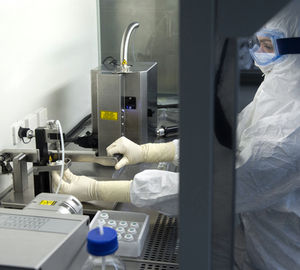
Their Central Pharmacy is a reference for the entire region and is equipped with Crystal L1 Robot Line in restricted access barrier system (RABS) for safer and larger aseptic filling campaigns of parenterals, tailored to the needs of the patients.
Some pharmaceutical compounds are not available on the market in the required form or concentration. That presents a challenge for big hospital structures, like Lille University Hospital, France. There is no other solution for their Central Pharmacy than re-conditioning existing commercial forms or even compounding a suitable drug from the API. When it comes to parenterals, it becomes more complicated and riskier.
To ensure required safety of the drug, the Central Pharmacy of the Hospital operates in several controlled atmosphere areas (Grade B and C), allowing the preparation of many injectables drugs. In order to automate and de-risk such aseptic filling processes, the Central Pharmacy was looking for a robotic fill & finish line.

With almost 16,000 healthcare professionals and 3,322 beds, the Lille University Hospital (Centre Hospitalier Universitaire de Lille) in France is one of the largest public healthcare institutions in Northern Europe. The reach of this innovation and research hospital encompasses the 6 million inhabitants of the Hauts-de-France region.
Beside the University Hospital itself, the Central Pharmacy is the reference for other 9 healthcare structures in the area.
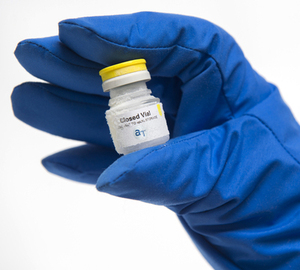
The introduction of the AT-Closed Vial® technology enables the Central Pharmacy to produce stable forms of injectable drugs in greater quantities and helps to better meet the expectations of patients treated by the University Hospital and associated structures.
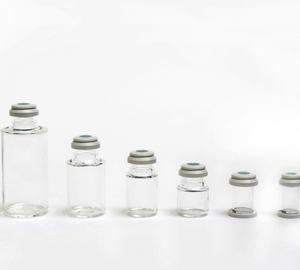
The CHU runs the automated aseptic filling line, Crystal L1 Robot Line, installed in restricted access barrier system (RABS) in Grade B, and is able to process various volumes of AT-Closed Vial®, covering various hospital injectable products needs.
Head of Central Pharmacy, Lille Hospital University (CHU)
Starting from 2021, thanks to a Crystal L1 robotic equipment by Aseptic Technologies, repartition of injectable compounds is now possible at large scale and in safest conditions for the patient. Moreover, stability tests conducted by the research unit attached to the Central Pharmacy (Groupe de Recherche sur les forms Injectables et les Technologies Associées, ULR 7365), on several commercial products have shown either longer shelve life or useful stability outside the fridge, when filled in AT-Closed Vial® compared to storage of the same in more conventional containers such as polypropylene syringes.
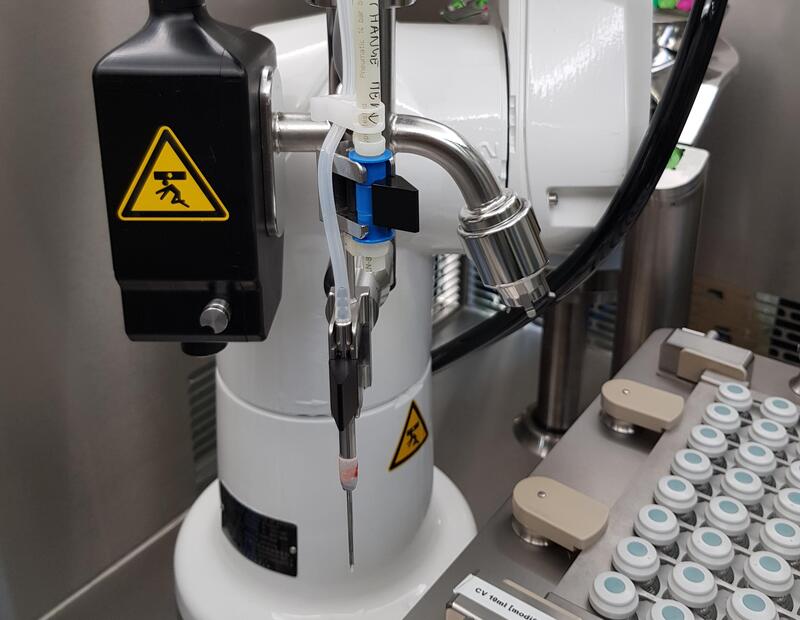
Technology enabling rapid deployment and validation.
For a selection of injectable products, common to hospital use.
As a scaling-up solution from manual process with AT-Closed Vial®.